Many individuals perceive skincare as a superficial treatment – serums, SPF, and sometimes a mask.
However, the most important cellular regeneration your skin will go through occurs at night, and this cannot be replaced by any product.
Sleep represents the time for your skin to repair itself. It is during this time that your body will produce the cells it needs to rejuvenate the skin and the tissues in depth.

What Actually Happens To Your Skin While You Sleep
During deep sleep, the pituitary gland releases growth hormone, which tells the body to repair itself.
Your cells start to repair damaged tissue, collagen production increases, and the tiny muscle tears that occur during the day because of environmental pollutants and UVB exposure begin to heal.
This restorative process is dictated by our internal body clock and it doesn’t just require sleep, it needs to happen at the right time too.
Melatonin, besides acting as a natural sleep aid, functions as a powerful antioxidant, counteracting the day’s worth of oxidative stress that builds up from pollution and exposure to chemicals.
There is no antioxidant serum that can replicate what happens when the body produces melatonin under the right conditions.
One more reason bedtime is the right time for skincare: as we sleep, transepidermal water loss increases, which is the amount of water that evaporates from the skin’s surface.
That may not sound good, but it actually is. When the barrier is more permeable, there is greater penetration of ingredients in products, and more drinking in of humectants in those products, which increases their efficacy.
Moving From External-Only To Internal-First
Many people approach beauty entirely externally.
They will invest in products but won’t address anything that is happening further upstream.
The shift that is worth making is seeing sleep quality as the foundation that will determine how effective those products can actually be.
That means taking sleep latency seriously – the longer it takes to fall asleep, the more deep sleep you lose.
Deep sleep is where human growth hormone peaks, where the real structural repair happens.
Lose even 90 minutes of it and your body’s ability to repair and shed damaged cells diminishes significantly.
There are multiple strategies including good sleep hygiene (consistent sleep and wake times, reduced light exposure in the evenings, a cool room) but for people who struggle to wind down, natural approaches to calming the nervous system before bed are seen as part of the self-care routine.
It’s what leads people to approaches like The Hemp Doctor Delta 8, which works through the endocannabinoid system.
The endocannabinoid system (ECS) is implicated in regulating both sleep-wake cycles and skin homeostasis, hence it is relevant to both ends of this conversation.
The Cortisol Problem
Lack of sleep doesn’t just slow down repair – it actively speeds up damage. When we skimp on sleep, cortisol is left unregulated.
Cortisol is a problem because it breaks down collagen and elastin, the building blocks of skin.
Over time, this translates to collagen damage and the early signs of aging such as fine lines, lack of elasticity, and skin that doesn’t rebound.
“Inflammaging” is the term used to describe accelerated skin aging that results from low-grade, chronic inflammation.
Poor sleep is a major trigger of inflammaging. If the skin’s circadian rhythm is regularly thrown off, no amount of cream will counteract that inflammation in any meaningful way.
Perhaps most visibly, though, the periorbital zone – what we think of as dark circles – is a telltale sign of disrupted microcirculation.
During healthy sleep, blood flow to the skin increases, helping to create a healthy glow. Poor sleep produces vascular congestion in the skin surrounding the eyes, and this shows up very quickly.
According to a study in the journal Royal Society Open Science, observers were able to tell when a person was sleep-deprived after as little as two nights, noting increased skin paleness, as well as more wrinkles and droopy eyelids. Two nights. That’s all it takes.
Building A Routine That Actually Works
The solution at a tactical level is simple: set a consistent sleep window so you’re getting 8 hours.
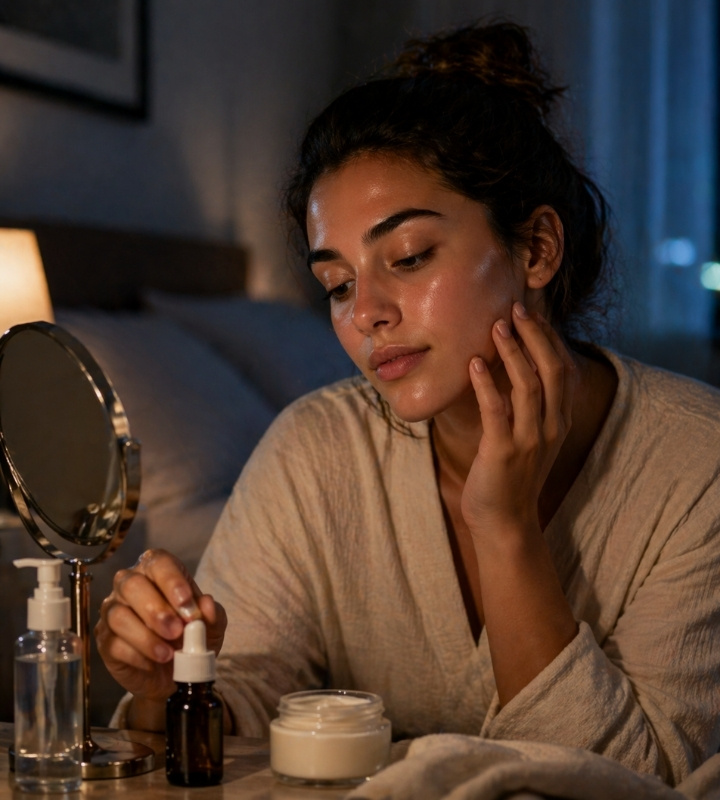
Change your relationship to your skincare products so that you regard your p.m. routine as a chance to support your biology as it synthesizes necessary ingredients, rather than as an expected magic trick in itself.
Then, remove or mitigate the issues coming between you and consistent deep sleep.
For way too many people, the missing step is looking at the stuff on the sink when they should be looking at the stuff that’s happening inside their bodies.
The production of collagen, melatonin secretion, and even human growth hormone output that happens during your sleep cannot be replicated with topicals, no matter how expensive.
Those ingredients are created when the conditions are right. Fixing the internal chemistry is more important than anything you can put on your face.