Check these if you always buy medicines from online pharmacies
Well! Post-covid setup says that most of us prefer buying medicines from online pharmacies only as it is more convenient. But, is the habit good or bad? Let's check out.
Have you ever scrolled through a baby registry and wondered why anyone needs nine different lotions?
Or stood in a shop holding a bottle warmer, unsure whether you’ll use it past the first week?
Expecting and new parents hear plenty about what to buy and very little about what to skip.
With so many products marketed as must-haves, it’s easy to end up with crowded shelves and supplies you rarely use.
This guide sorts baby and mother care essentials into a simpler routine, covering gentle bathing, diaper changes, feeding supplies, the mother’s comfort, and how to read product labels with confidence.
Quick answer: A practical baby care routine usually rests on five things: diaper-changing supplies, gentle cleansing and basic skincare, feeding equipment that suits how your baby is fed, comfort and recovery items for the mother, and a simple way to store and restock.
Everything else depends on your baby’s needs, your feeding method, and how you’re recovering.
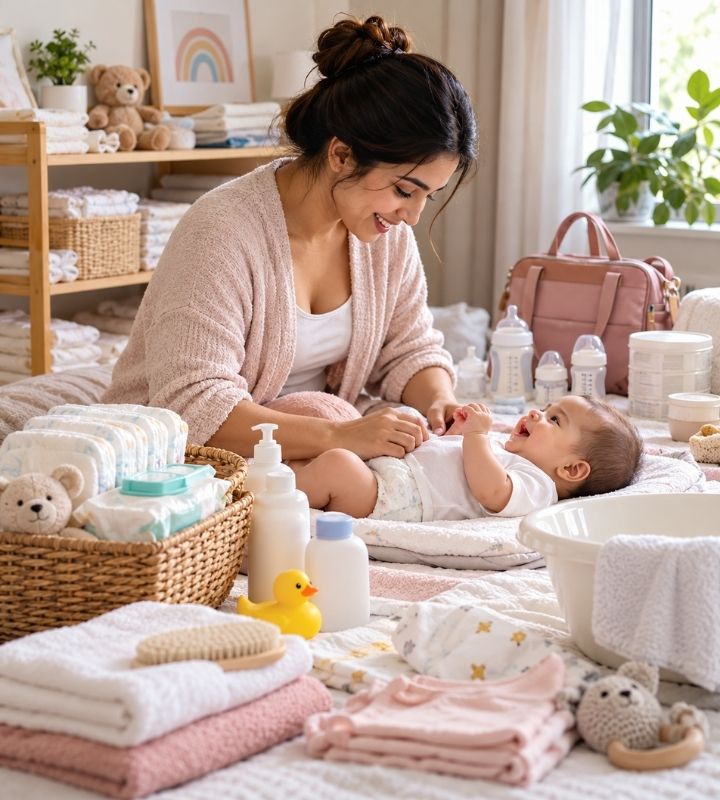
Newborns don’t need a bath every day. The American Academy of Pediatrics says three baths a week during a baby’s first year may be enough, as bathing too frequently can dry out the skin.
The American Academy of Dermatology also suggests bathing newborns two to three times a week, provided the diaper area is cleaned thoroughly during changes.
Until the umbilical cord stump falls off, stick to sponge baths.
The basic bath-time kit is short:
If your baby’s skin looks dry after bathing, an appropriate moisturizer may help. Bathing less frequently can also reduce dryness.
Once your baby moves to a baby bathtub, constant supervision matters more than additional bath accessories. Keep your baby securely supported and never leave them unattended in or near water.
Keeping everything within reach makes diaper changes more manageable, particularly during nighttime feeds or when you’re caring for your baby alone.
Picture a small basket beside your changing spot containing:
A simple barrier cream can help protect the diaper area when needed, although not every change requires one. If irritation persists, worsens, or looks unusual, ask your pediatrician rather than repeatedly trying different products.
Buy diapers in smaller quantities initially. Babies grow quickly, and buying several large packs before checking the fit can leave you with unused supplies.
You don’t need an elaborate changing station, either. One organized basket at home and a compact pouch in your diaper bag may be enough.
Never leave your baby unattended on a raised changing surface, even for a moment. Keep one hand on your baby and have everything ready before starting.
Start with how your baby will be fed rather than a long list of feeding gadgets.
Bottle-feeding generally requires suitable bottles and teats, a dedicated cleaning brush, and a clean basin used only for feeding equipment.
Breastfeeding may call for nursing pads, comfortable clothing, or other support items, depending on your experience.
Some accessories are useful in particular circumstances but aren’t necessary for every family.
For example, a breast pump may be helpful if you regularly express milk or spend time away from your baby. A bottle warmer might offer convenience, but it isn’t essential to every feeding routine.
Before investing in extra equipment, consider how often you’ll realistically use it.
Proper cleaning is more important than owning additional feeding gadgets. The US Centers for Disease Control and Prevention (CDC) recommends cleaning bottles and their separate parts after every feeding and allowing them to air-dry thoroughly.
The CDC also recommends daily sanitizing for babies younger than two months, those born prematurely, and those with weakened immune systems.
A dishwasher using hot water with a heated drying cycle or sanitizing setting can eliminate the need for a separate sanitizing step when items are dishwasher-safe.
Following appropriate hygiene guidance helps you build a safer, more manageable feeding routine without unnecessary accessories.

Baby products often receive most of the shopping attention, but a mother’s comfort and recovery deserve just as much consideration.
During the postpartum period, your needs may change from week to week.
Instead of purchasing every maternity accessory in advance, focus on practical supplies that support your comfort and daily care.
Useful starting items may include:
For example, a mother recovering after delivery might keep maternity pads, clean underwear, a water bottle, and comfortable clothing accessible in the bedroom.
Someone breastfeeding regularly might also keep nursing pads and a clean cloth near their usual feeding spot.
These small arrangements can reduce unnecessary trips around the house, particularly during exhausting nights.
Follow your midwife’s or doctor’s instructions for perineal care, stitches, and suitable postpartum products.
Seek medical advice promptly if bleeding becomes unusually heavy, you pass large clots, develop a fever, or notice an unpleasant-smelling discharge.
A practical care routine should support the mother’s recovery as well as the baby’s needs.
Front labels are designed to attract attention, but ingredient lists can tell you more about what’s actually in a product.
Consider the difference between fragrance-free and unscented.
A fragrance-free product is generally marketed as having no added fragrance, while an unscented product may contain fragrance ingredients that mask other odors.
The US Food and Drug Administration (FDA) notes that fragrance ingredients may sometimes appear on a cosmetic label under general terms such as “fragrance” or “perfume.”
Imagine comparing two baby lotions. One says “gentle, unscented, with natural extracts,” while another says “fragrance-free.”
Instead of choosing based only on the front label, turn both bottles around and read their ingredient lists. Check for fragrance ingredients and follow any age-related instructions.
Terms such as “natural” and “hypoallergenic” also deserve careful attention.
They do not automatically mean that a product is irritation-free or suitable for every baby.
In the United States, the FDA does not establish a uniform federal definition for the marketing term “hypoallergenic.”
No single label claim guarantees that a product will suit every baby’s skin.
Choose products according to your baby’s age and individual needs, introduce unnecessary new skincare products cautiously, and seek professional guidance if persistent irritation or unusual skin reactions develop.
Once you understand your daily routine and what to look for on product labels, shopping becomes easier to organize.
Rather than browsing every available accessory, group your purchases around the activities you perform regularly: diaper changing, bathing, feeding, and personal care.
Start by checking what you already own. Then identify genuine gaps before buying anything additional.
Shopping collections organized by routine can make this process more straightforward.
Beauty Box JO, a Jordan-based retailer, groups its baby and mother care products into categories including diapering, feeding, bath time, and breastfeeding and maternity essentials.
You can use these categories as a reference when reviewing your own checklist, while checking product suitability and availability before purchasing.
Here’s a practical way to separate everyday necessities from optional purchases:
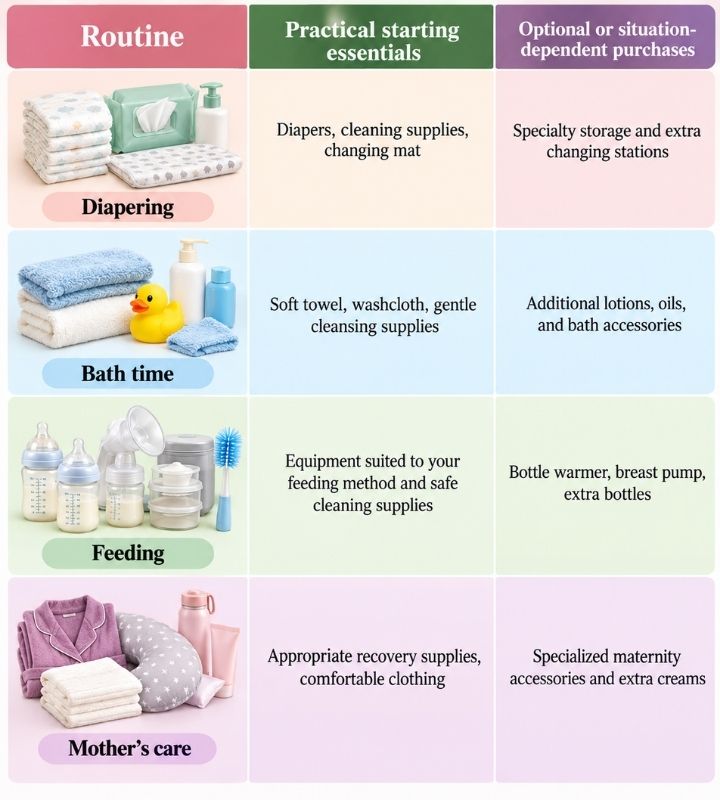
The aim isn’t to own the fewest products possible. It’s to choose supplies that genuinely make everyday care easier.
Even with a shopping checklist, a few habits can lead to unnecessary purchases.
Large packs of diapers, multiple skincare products, or several types of feeding accessories may go unused if your baby’s size, preferences, or needs change.
Using several lotions, cleansers, and oils isn’t automatically better than a simple routine.
Extra products can make it harder to identify what causes irritation if your baby’s skin reacts.
A specialized organizer or feeding gadget might look useful, but your daily habits will show whether it solves a genuine problem. Start with basics and add equipment when you identify a need.

Gentle cleansing and an appropriate fragrance-free moisturizer may help with ordinary dryness.
Reducing unnecessary bathing can also help. If redness, dryness, or a rash persists or worsens, consult your pediatrician.
No. Begin with basic diapering, bathing, feeding, and maternal recovery supplies.
Additional accessories can be purchased once you understand which products fit your family’s daily routine.
A more practical baby and mother care routine doesn’t begin with a bigger shopping list. It begins with understanding what makes daily care easier for both of you.
Review the supplies you already own, organize them by routine, and identify what’s genuinely missing.
Read product labels carefully, choose essentials that suit your circumstances, and add new items only when there’s a clear need.
A few well-chosen basics can help you care for your baby comfortably while leaving more time, space, and energy for your own recovery.

Well! Post-covid setup says that most of us prefer buying medicines from online pharmacies only as it is more convenient. But, is the habit good or bad? Let's check out.

The specific precious metal you choose can enhance your beauty […]

Chemicals are used in most hair care products that can make your hair dull and brittle. Thus, in this article, we are going to discuss 10 best natural ingredients for hair that help to ass lustre & life to your hair minus the woes.

Explore the trendiest hime cut hairstyle, its history, maintenance, and many other tips about one of the most popular hairstyles ever.

Scalp Micropigmentation might be a permanent solution to solve hair loss trouble. But, before a sitting, know the crucial things about the procedure first. And, this article can be your one-stop guide for that.

In this article, alongside exploring the potential of CBD oil, we would also talk about its side effects. Let's delve into the science behind CBD world.

Whether you have wedding or sangeet, whether you have a festival or any ocassion, all these designs are curated just for you.
Beauticians often find it tiresome to run between appointments and clients. Here is a guide how they can manage their busy schedule.

True beauty isn’t found in products alone—it’s built on everyday habits like hydration, nutrition, sleep, and self-care. Here’s how to glow from within.

When it comes to the best place to get hair transplantation done, Turkey is pretty popular. There is a long list of reliable clinics performing high-quality hair transplants methods, such as DHI, FUT, and FUE. But, what makes the country ideal for dream hair? Know the details.

Learn why toddler dental care matters, how to brush properly, prevent cavities, and when to see a trusted pediatric dentist in Singapore.

Explore how beauty and wellness now work together—combining self-care, body confidence, and mindful routines for a more balanced, modern approach.