Why Multivitamins for Skin & Hair Became a “Beauty Essential” in India
A few years ago, most of us believed skincare ended with what we applied on our face—cleansers, creams, serums, sunscreens. If something went wrong with our skin or hair, we simply changed products.
That mindset has changed.
Today, beauty is increasingly being linked to what we consume. Skin and hair multivitamins have quietly become a part of daily life for many Indians—especially women.
They are often started during phases of hair fall, dull skin, fatigue, or hormonal changes, usually without much thought or medical testing.
I don’t find this surprising.
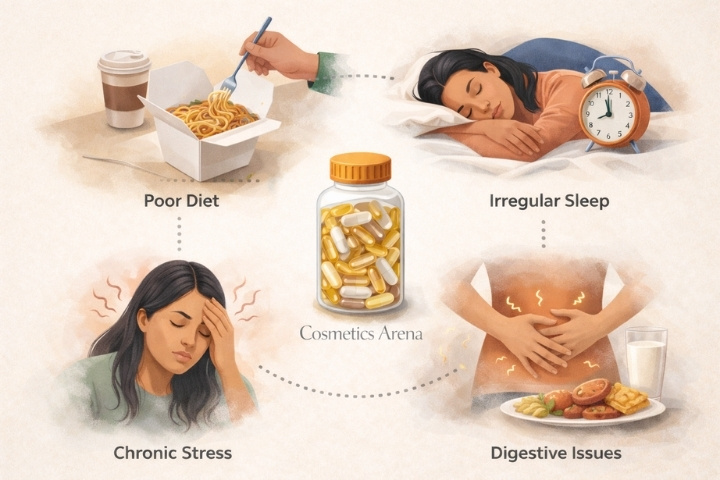
Our lifestyles have changed more than we realise. Meals are often rushed, protein intake is low, stress is constant, sleep cycles are irregular, and digestive issues like bloating or acidity have become almost normal.
When skin starts looking tired or hair begins shedding more than usual, taking a supplement feels like the easiest and safest step.
And to be fair, many people do notice changes after starting multivitamins. Hair fall may reduce, skin may look brighter, and energy levels often improve.
This is usually enough to convince us that the supplement is “working.”
But this is where things get interesting.
What most of us don’t stop to ask is whether these multivitamins are actually improving our skin and hair—or simply correcting something that was missing in the first place.
That distinction matters. Because supplements don’t work the way they are marketed. They don’t directly target skin or hair. They work through the body, and the body has its own priorities.
Understanding this is important before we decide whether skin and hair multivitamins are truly necessary—or just a temporary fix.
Why the Body Does Not Prioritise Skin & Hair (And Why Supplements Feel Slow)
One thing most supplement advertisements never explain is how the human body actually uses nutrients.
When we swallow a multivitamin, those nutrients do not travel straight to our hair follicles or skin cells. The body doesn’t work with a beauty-first approach. It works on survival.
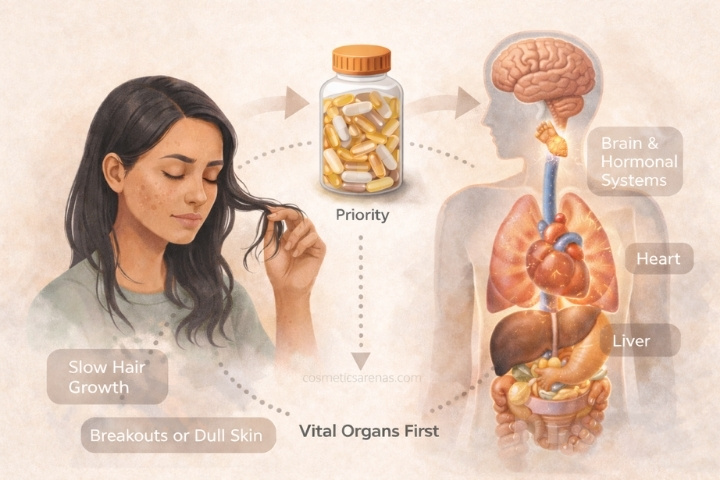
The first priority is always vital organs—your brain, heart, liver, and hormonal systems. Only after these needs are met does the body “spend” nutrients on non-essential tissues like skin and hair.
This is why skin and hair often show problems first when something inside the body is off. Hair fall, dullness, breakouts, or delayed healing are not random issues.
They are early signals that the body is struggling to meet its internal demands.
So when someone starts a skin or hair multivitamin and sees improvement, it usually means one of two things.
Either there was an underlying deficiency—iron, Vitamin D, B12, zinc, or even protein—that was silently affecting the body. Or the body finally received enough nutrients to move beyond survival and redirect some resources to repair skin and support hair growth.
This also explains why results are never instant.
Skin cells take weeks to renew. Hair grows even slower—roughly a centimeter a month. Supplements may improve energy or reduce hair shedding first, while visible changes in hair density or texture take months, not days.
It also explains why two people taking the same multivitamin can have completely different outcomes. One may see clear improvement, while the other sees nothing at all.
The difference is not the supplement—it is what the body needed at that moment.
Once we understand that skin and hair are the last in line, it becomes easier to see why supplements sometimes work, sometimes disappoint, and often take time.
They are not beauty products. They are nutritional support—and they only help when the body actually needs them.
Why Many People Feel Results-Even When the Supplement Isn’t “Special”?
This is the part that often confuses people.
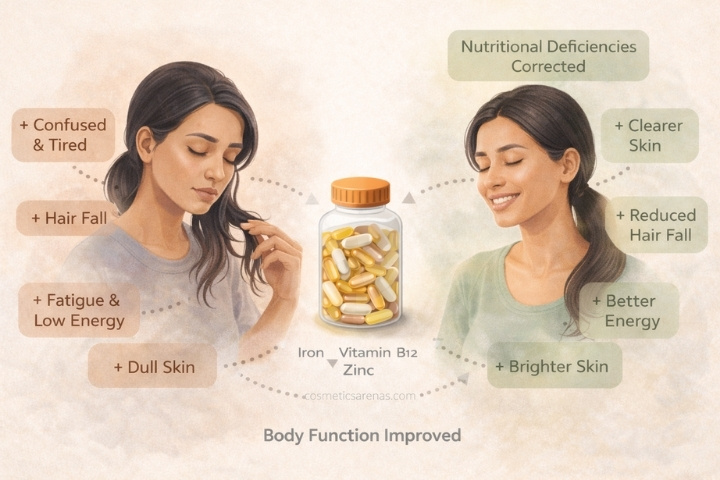
Someone starts a skin and hair multivitamin, and within a few weeks they notice changes—hair fall reduces, skin looks brighter, energy improves. Naturally, the supplement gets all the credit.
But in most cases, the improvement has very little to do with the supplement being extraordinary.
What’s actually happening is much simpler.
Many Indians walk around with mild, undiagnosed deficiencies for years. Not severe enough to show up as illness, but enough to quietly affect hair growth, skin repair, and overall energy.
When a multivitamin is introduced, it often corrects one or two missing links—iron, vitamin D, B12, zinc, or even basic B-complex support.
Once those gaps are filled, the body starts functioning closer to normal.
Hair fall reduces because the body is no longer under nutritional stress. Skin looks better because cell turnover improves. Energy picks up because metabolic processes finally have the raw materials they need.
This improvement feels dramatic because the body was running below optimal levels earlier.
And that’s why the same supplement can feel life-changing for one person and completely useless for another. One body needed correction. The other didn’t.
There’s also another factor we don’t talk about enough—consistency.
When people start supplements, they often:
- Eat meals more regularly
- Drink more water
- Pay more attention to sleep
- Become more conscious of health
These small behavioral changes quietly amplify results, even though the supplement gets all the credit.
This doesn’t mean supplements are useless. It simply means their role is often misunderstood.
They are not creating beauty from scratch. They are helping the body return to balance.
Once you look at it this way, it becomes easier to understand why results plateau after a few months, or why stopping a supplement doesn’t always reverse the benefits immediately.
The supplement did its job—it removed an obstacle. What happens next depends on how the body is supported overall.
The Nutrients That Actually Matter for Skin & Hair (And Why Most Labels Are Overcrowded)
If you’ve ever turned a multivitamin bottle around and read the label, you’ve probably noticed one thing—it’s crowded.
Long lists of vitamins and minerals, many of them in tiny amounts, all packed into a single tablet and marketed as a complete solution for skin and hair.
But the body doesn’t work on quantity. It works on relevance.
Not every vitamin listed on a skin and hair supplement plays an active role in improving how your skin looks or how your hair grows.
Some are essential, some are supportive, and some are included simply because they look impressive on a label.
For Indian bodies and lifestyles, only a small group of nutrients consistently makes a noticeable difference—and only when there is a deficiency.
Vitamin D: The Most Commonly Missed Link
Despite living in a tropical country, Vitamin D deficiency is extremely common in India. Long indoor hours, covered clothing, pollution, and sunscreen use all reduce effective sun exposure.
Low Vitamin D doesn’t just affect bones. It is often associated with:
- Increased hair shedding
- Slower hair regrowth
- Poor skin repair and inflammation
When Vitamin D levels are corrected, many people notice reduced hair fall and better scalp health—not because the supplement targets hair, but because the body is finally functioning more efficiently.
Iron: Especially Relevant for Women
Iron deficiency is another silent issue, particularly among Indian women.
Heavy menstrual cycles, vegetarian diets, and poor absorption often lead to low iron stores. Hair follicles are extremely sensitive to reduced oxygen supply, and iron plays a key role in delivering oxygen to tissues.
When iron levels drop:
- Hair enters the shedding phase more easily
- Hair strands become weaker
- Regrowth slows down
Correcting iron deficiency can significantly improve hair fall—but iron is not something to supplement casually. It works when needed, and causes problems when overused.
Vitamin B12 and B-Complex: Energy First, Hair Later
Vitamin B12 deficiency is common, especially among vegetarians. Low B12 often shows up as fatigue, brain fog, low mood, and sometimes diffuse hair thinning.
When B12 levels improve, energy usually improves first. Hair and skin changes follow slowly. This is another reminder that supplements support internal systems before cosmetic outcomes become visible.
Biotin, often highlighted in hair supplements, is part of this group. While biotin does support keratin production, true deficiency is rare.
When hair improves after taking biotin, it is often because other deficiencies are being corrected at the same time.
Zinc: Small Mineral, Visible Impact
Zinc plays a role in:
- Scalp health
- Oil balance
- Skin healing
Low zinc levels can show up as persistent acne, scalp irritation, or delayed wound healing.
Correcting zinc deficiency can improve skin clarity and scalp comfort, but excess zinc can disturb other mineral balances. Again, relevance matters more than quantity.
Why Most Multivitamins Contain Too Much—and Too Little
Many skin and hair multivitamins include everything from vitamins A to K, trace minerals, herbal extracts, and antioxidants—all in one pill.
The problem is not inclusion. The problem is focus.
Formulas often include key nutrients in amounts too low to correct a deficiency, while brands add unnecessary ones to make the supplement look comprehensive. This creates the illusion of completeness without delivering targeted support.
This is why people often feel initial improvement and then hit a plateau. The supplement corrected a mild deficiency—but beyond that, it has very little to offer.
Understanding which nutrients actually matter helps set realistic expectations. Skin and hair don’t need everything. They need the right things, at the right time, in the right amounts.
Why Digestion and Absorption Decide Whether Supplements Work at All
People rarely discuss this in conversations about skin and hair supplements, even though it may be the most important factor of all.
You can take the best multivitamin every single day, but if your digestion isn’t working well, your body may not absorb much of it.
In Indian lifestyles, digestive discomfort has become almost normal.
Bloating, acidity, heaviness after meals, irregular bowel movements—many people live with these symptoms without realizing how deeply they affect nutrient absorption.
When digestion is compromised, nutrients pass through the gut without being properly absorbed into the bloodstream.
This means vitamins and minerals never reach the organs that need them, let alone skin or hair.
Late dinners, frequent snacking, high sugar intake, excess dairy, and long gaps between meals all put stress on the digestive system.
Over time, this affects stomach acid levels and gut lining health—both of which are essential for absorbing nutrients like iron, vitamin B12, and zinc.
This is why two people can take the same supplement and have completely different outcomes. One absorbs it well. The other doesn’t.
Many people also notice something interesting: when they improve their digestion—by eating earlier, simplifying meals, drinking enough water, or reducing heavy foods—their skin and hair start improving even without changing supplements.
This is not a coincidence.
The body can only work with what it can absorb. Supplements don’t bypass digestion. They depend on it.
So when someone says a multivitamin “didn’t work” for them, the issue is often not the supplement itself, but the environment inside the body.
Supporting digestion is not glamorous. It doesn’t come in shiny bottles. But it quietly decides whether any skin or hair supplement will ever make a difference.
Can Skin & Hair Multivitamins Be Taken Long-Term? (And When to Stop)
This is one of the most common questions people ask once they start seeing results.
If a multivitamin is helping my skin and hair, can I just continue taking it indefinitely?
The honest answer is—not without reassessment.
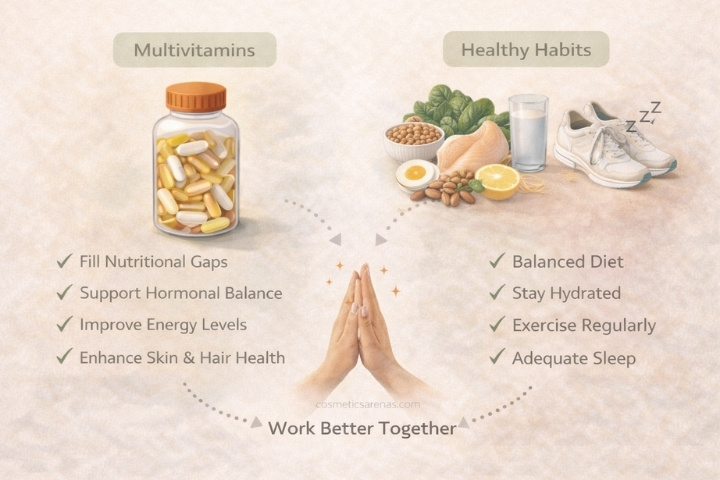
Skin and hair multivitamins support the body when something is missing. Once the deficiency is corrected, the body’s needs change.
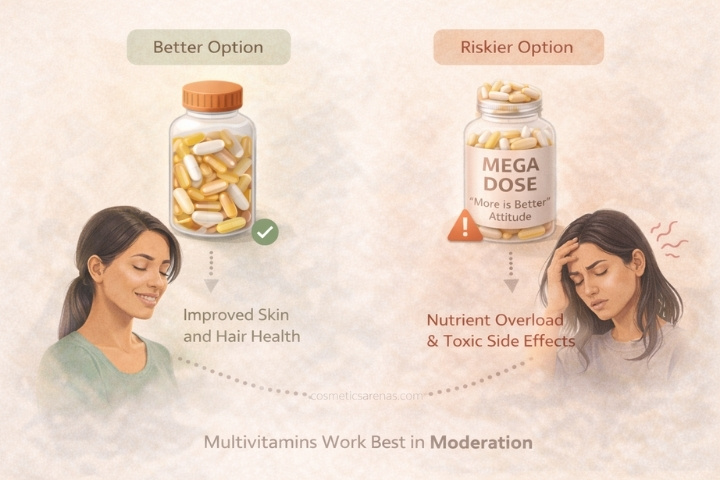
Continuing the same supplement blindly may not add further benefit, and in some cases, it can create imbalance.
Not all vitamins behave the same way in the body.
Water-soluble vitamins, like most B vitamins and Vitamin C, are generally excreted if taken in excess. This makes them relatively safer, but it also means taking more than required doesn’t necessarily translate into better results.
Fat-soluble vitamins—such as vitamins A, D, E, and K—are stored in the body. Over time, unnecessary supplementation can lead to accumulation, which may cause subtle but real issues, especially when taken without monitoring.
This doesn’t mean supplements are dangerous. It means they are meant to be used with intention, not habit.
Many people notice that skin and hair improvements plateau after a few months. This is often the body’s way of saying that the original gap has been filled.
Continuing beyond this point may maintain results, but it rarely improves them further.
A more sensible approach is to treat skin and hair supplements as temporary support:
- Use them during periods of high stress, hormonal changes, recovery, or dietary imbalance
- Reassess after a few months
- Focus on food, digestion, and lifestyle as long-term foundations
Taking breaks is not a setback. In fact, it helps you understand whether the supplement is still necessary.
When the body is supported well through nutrition and routine, supplements naturally move into the background. And that’s exactly where they belong.
What Actually Sustains Healthy Skin & Hair (Beyond Pills)
Once the initial excitement around supplements settles, one thing becomes clear—no pill can compensate for everyday habits that consistently work against the body.
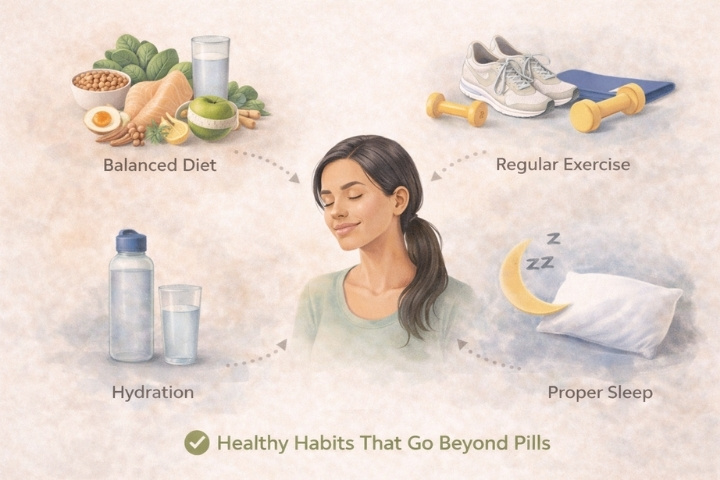
You don’t build healthy skin and hair through isolated actions. You build them by supporting the body consistently, day after day.
One of the most overlooked factors in Indian diets is adequate protein. Hair is made of keratin, and skin relies on continuous protein turnover for repair.
When protein intake is low, no amount of vitamins can fully compensate. This often shows up as slow hair regrowth or skin that looks tired despite supplementation.
Meal timing matters too. Long gaps between meals, very late dinners, or erratic eating patterns affect blood sugar stability and digestion.
Over time, this internal stress reflects on the skin and scalp. Many people notice improvement simply by eating earlier and more regularly.
Sleep is another silent contributor. Skin repair and hair growth hormones are closely linked to sleep quality. Chronic sleep deprivation quietly undermines even the best skincare or supplement routine.
Sunlight exposure, often avoided out of fear of tanning, is essential for vitamin D synthesis. Short, sensible exposure plays a role not just in bone health, but also in immune balance and hair follicle function.
Stress deserves special mention. Chronic stress alters hormone levels, digestion, and nutrient utilization.
Hair fall during stressful periods is not a coincidence—it is a physiological response. Until stress is addressed, supplements can only do so much.
When these foundations are in place, supplements work better—or become unnecessary. When they are ignored, supplements often feel inconsistent or disappointing.
You don’t build skin and hair health by adding more products or pills. You sustain it by creating an environment where the body can function without constant compensation.
Are Multivitamins Really Necessary?
Multivitamins are often marketed as a shortcut to glowing skin and stronger hair, but the truth is more nuanced.
Much of the multivitamin hype today comes from short-form social media posts that oversimplify complex nutritional needs.
Vitamins and minerals do play a role in skin repair, collagen formation, and hair growth cycles—but taking them in supplement form doesn’t automatically mean visible results.
If your body isn’t deficient, extra vitamins rarely translate into extra glow or faster hair growth.
For people with actual nutritional gaps—such as low vitamin D, iron, B12, or zinc—supplementation can genuinely help improve skin dullness, fatigue-related hair fall, or slow recovery.
In such cases, multivitamins act more like corrective support, not beauty boosters. This is why many people see improvement initially and then hit a plateau.
The body absorbs only what it needs and discards the rest, which explains why supplements alone can’t compensate for poor diet, sleep, stress, or hormonal issues.
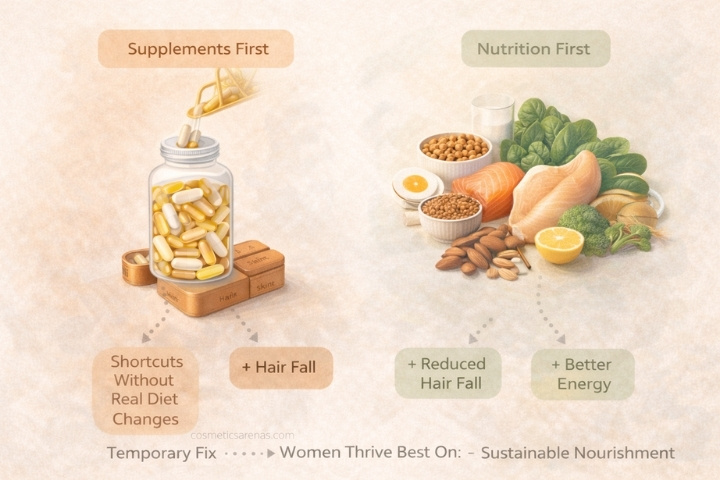
In most cases, real improvements in skin and hair still come from nutrition, lifestyle, and consistency—not from pills alone.
Final Thoughts — Supplements Are Support, Not Solutions
Skin and hair multivitamins are not useless. But they are also not the miracle solutions they are often made out to be.
In most cases, they work because they correct something the body was lacking—sometimes something we didn’t even realise was missing.
Once that gap is filled, the body does what it is designed to do. Skin repairs itself more efficiently.
Hair shedding stabilizes. Energy improves. The supplement gets the credit, but the body does the real work.
Problems begin when supplements are treated as permanent fixes rather than temporary support.
When taken without understanding, without reassessment, and without attention to digestion, diet, and lifestyle, they often stop delivering results or create new imbalances.
The truth is simpler and less exciting than marketing claims.
Healthy skin and hair are not built by adding more pills. They are sustained by supporting the body consistently—through nourishment, rest, digestion, and balance.
Supplements can help during certain phases, but they are not meant to replace these foundations.
If a multivitamin is helping you, that’s a signal worth listening to. It means your body needed support.
The next step is not to depend on it forever, but to understand why it helped—and how to support your body better in the long run. That awareness is far more powerful than any supplement label.