How to keep your nebraska cosmetology ce affordable
Need to renew your Nebraska cosmetology license? Learn how to keep your continuing education (CE) affordable without compromising on quality.
Discover what most doctors skip when discussing double chin removal, the real options, results, and what actually works for lasting change.
By Keith Myers
Posted on | Last Updated
It’s quietly maddening to sit down with a doctor and ask about your double chin and walk out with a brochure for liposuction.
This was the default dialogue for years. Surgery or nothing.
But the double chin removal world has changed a lot, and most people don’t get the whole story.
Not because the doctors are hiding some sinister thing, but because the conversation doesn’t go deep enough.
That changes right here.
Most people think of a double chin as a weight issue only. But the truth is more complex than that.
Submental fat, the clinical term for fat under the chin, is one of the most stubborn fat deposits in the human body.
There’s a genetic aspect that makes it resistant to even the most disciplined diet and exercise.
Some people develop a visible double chin at a healthy body weight because of the way their body deposits fat.
For some, it is a gradual process that comes with age as the skin loses its elasticity and the jawline softens.
What sets them apart, which directly affects what removal method will actually work for a given person, is important to understand.
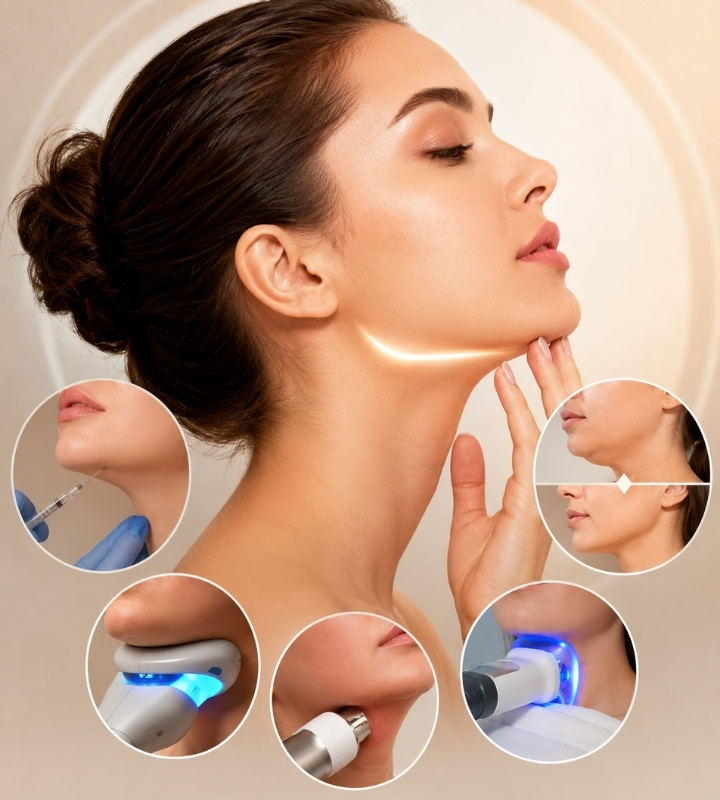
This is something that is often glossed over in consultations.
The degree of skin laxity, or how loose or tight the skin is in the submental region, is a major factor in deciding which treatment will yield visible results.
Someone with firm elastic skin and a pocket of stubborn fat will respond beautifully to a fat dissolving injection.
Someone with a lot of skin looseness needs a treatment that also tightens. The wrong approach results in disappointment and wasted investment.
Deoxycholic acid is a natural molecule in the body that helps break down dietary fat.
It is synthesized and injected into the submental fat, where it permanently destroys fat cell membranes.
The body then slowly clears away and destroys those cells over weeks.”
It works best for patients with moderate fat deposits and good skin tone.
The results are gradual and usually noticed after 2-4 sessions. One of the most attractive benefits is the lasting result. Once those fat cells go, they’re gone forever.
High Intensity Focused Ultrasound, or HIFU for short, is one of the most talked about non-invasive options in the aesthetics world.
It provides targeted delivery of ultrasound energy deep into the foundational layers of the skin, stimulating collagen production and tissue contraction.
That is what separates HIFU from fat dissolving injections. It’s not just about the fat. And it firms the skin at the same time.
HIFU provides an appealing synergistic effect for patients with primary concern of skin laxity or those wishing for both fat reduction and jawline definition.
Radiofrequency devices work in a similar fashion, using heat energy to promote collagen and tighten tissue.
These treatments are often layered together in a single session at a reputable aesthetic clinic, giving you a more complete result than any one technology alone.
CoolSculpting is based on the science of cryolipolysis.
It kills fat cells by freezing them through controlled cooling leaving no damage to the surrounding tissue.
It uses a specially designed applicator that sits under the chin and targets the submental fat pocket directly.
Results take time to develop—usually two to three months—as the body clears away the treated cells.
This technique is especially attractive in patients who want to avoid injections and have a well-demarcated fat pocket with relatively firm skin around it.
For patients with a lot of fat volume, liposuction under the chin is still the most definitive solution.
It gives you instant, dramatic results that you can’t always get from one round of non-invasive treatments.
The fact is, surgery is not better or worse in and of itself. It’s the right tool, just for the right profile of a patient.
Someone with a large amount of submental fat and who wants significant, rapid change may actually be better off getting a surgical consult.
The trick is to fit the solution to the individual, not to go to one extreme or the other.
The secret that changes everything is not actually about any specific treatment. It is about the quality of the consultation that precedes it.
A skilled practitioner does not lead with their preferred device or their most profitable service. During a proper assessment, they will carefully evaluate the following before recommending any treatment:
That assessment determines everything. Asking the right questions during a consultation, about skin laxity, about how many sessions are realistic, about what combination approach suits your anatomy, separates patients who get transformative results from those who feel disappointed after months of treatment.
Double chin removal is not a one size fits all solution. To treat it as such does a disservice to patients.
The real conversation begins with understanding the anatomy, respecting the complexity of the submental area and matching the treatment to the person, not the other way around.
Whether it is injections, energy based technology or surgery, the outcome is totally based on an informed and personalized decision. This is the secret. And here you have it.

These are some of the most common questions patients ask about double chin removal, including treatment options, downtime, results, pricing, and doctor-led treatment planning.
This depends entirely on the treatment chosen and the individual’s anatomy.
Non-invasive options like deoxycholic acid injections or CoolSculpting typically require two to four sessions spaced several weeks apart before noticeable changes become visible.
HIFU and radiofrequency treatments may show gradual improvements over three to six months as collagen remodeling takes place.
A thorough consultation will give you a realistic session estimate based on your specific submental fat volume and skin condition.
Most non-surgical treatments involve mild to moderate discomfort rather than outright pain.
Deoxycholic acid injections can cause a temporary burning or stinging sensation in the treated area that subsides within minutes. HIFU may produce a warm, prickling feeling during the procedure.
CoolSculpting involves an initial cold sensation that typically numbs quickly.
Topical anaesthetic is commonly applied before most treatments to keep the experience manageable.
Any discomfort experienced is generally short-lived and well within tolerance for most patients.
Not at all. Many patients who seek double chin removal are within a healthy weight range.
Submental fat has a strong genetic component, which means it can appear regardless of body weight or fitness level.
Slim individuals often find this area particularly frustrating precisely because no amount of diet or exercise seems to change it.
Double chin removal treatments are designed to target this localised fat pocket specifically, making them relevant for a wide range of body types.
The longevity of results depends on the treatment method used.
Fat-dissolving injections and CoolSculpting permanently destroy fat cells in the treated area, meaning those specific cells will not return.
However, significant weight gain after treatment can cause remaining fat cells to enlarge and a double chin to reappear over time.
Energy-based treatments like HIFU deliver collagen-stimulating benefits that last anywhere from one to two years before a maintenance session becomes beneficial.
Maintaining a stable weight is the most reliable way to preserve results long term.
If you have been consistent with a healthy lifestyle for six months or longer and your double chin has not responded, that is a strong signal that the fat is structural rather than weight-related.
Waiting it out in that situation rarely leads to change.
Speaking to a qualified professional at this point gives you a clear picture of what is actually happening beneath the skin and what realistic options exist for your specific anatomy.
Early intervention also tends to deliver better outcomes since skin elasticity is typically stronger, which makes non-invasive treatments more effective.

Need to renew your Nebraska cosmetology license? Learn how to keep your continuing education (CE) affordable without compromising on quality.

Learn how often you should get waxed for your face, legs, underarms, bikini, and more. Follow the ideal waxing schedule for smooth, long-lasting results.

Explore the top cosmetic treatments for women in 2026, from collagen-stimulating procedures and laser resurfacing to intimate aesthetics and labiaplasty.

Discover how lab automation is transforming the beauty industry. From precision formulation to enhanced compliance, automation ensures flawless consistency, faster production, and safer products. Learn why it's the future of cosmetic manufacturing.