A chipped front tooth, or a small gap you’ve noticed in every photo for years, usually ends up with one of two fixes: composite bonding or porcelain veneers. Both are tooth-coloured.
Both sit on the front surface, and once they’re on, most people couldn’t tell you which is which.
The decision comes down to two things you can’t see in the mirror.
How much enamel are you prepared to lose? And how often are you happy to go back to the chair?
For one small chip, bonding is the sensible place to start. It costs less and leaves the tooth mostly intact.
One visit is usually enough. Veneers make more sense when several front teeth need reshaping at once.
Neither will straighten crowded teeth or fix a bad bite, and a wide gap is often better closed with orthodontics first.
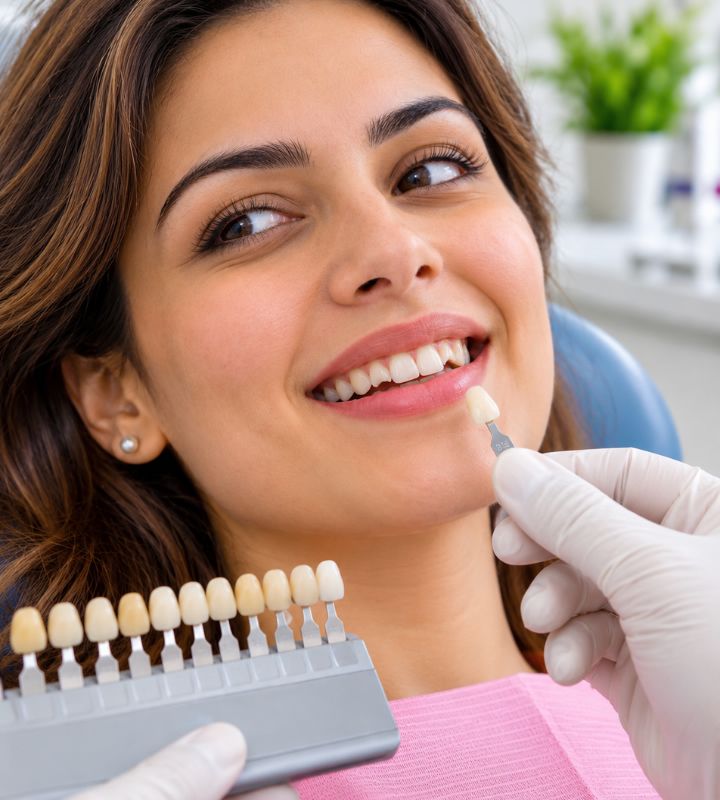
How bonding is done
The dentist roughens the front of the tooth slightly and paints on a bonding agent.
Composite resin goes on in thin layers, each one hardened under a blue curing light.
Then comes the part that takes real skill: shaping and polishing the last layer until the edge disappears against the teeth either side.
A single tooth often takes under an hour. Most people skip the injection, because nothing goes below the surface.
One thing catches people out. The resin is matched to your shade on the day, and it won’t whiten later.
Bond your front teeth in March, bleach them in June, and the bonded tooth is suddenly a shade darker than its neighbours. If whitening is on your list at all, do it first.
How veneers are fitted
Each veneer is a thin porcelain shell made in a dental lab.
At the first visit the dentist removes a thin layer of enamel, often about half a millimetre, so the veneer doesn’t sit bulky. A scan or impression goes off to the lab and you leave in temporaries.
A couple of weeks later you’re back, the veneers are checked for fit and shade, and they’re cemented on.
That half millimetre deserves more thought than it usually gets. Enamel doesn’t grow back.
A tooth prepared for a veneer will need a veneer or crown over it for good, so there’s no deciding in five years that you’d like the original tooth back.
What each costs per tooth
The price gap is wider than most people expect. Gorgeous Smiles in the Melbourne CBD lists bonding at $450 to $850 a tooth and porcelain veneers at $1,850 to $2,500. Even the cheapest veneer there costs more than twice the dearest bonding.
Scale it up to all four upper front teeth and the difference gets hard to ignore. Bonding comes to $1,800 to $3,400. Porcelain is $7,400 to $10,000.
Your own quote will shift with how much building up each tooth needs, and with whether X-rays or whitening come first. Health fund extras cover for cosmetic work is patchy.
Ask for the item numbers on your treatment plan and ring your fund before you sign anything.
How long they last
Bonding usually goes five to seven years before it needs a touch-up or a redo. Porcelain often lasts 10 to 15 years, sometimes longer.
Longer life narrows the gap a little.
Spread over a typical lifespan, a bonded tooth works out at somewhere around $110 a year and a veneer closer to $170.
Porcelain is still the dearer option, just by less than the sticker price suggests.
Repairs shift the sums again. A chipped bonded edge can usually be patched in one short appointment with fresh resin.
Porcelain can’t really be patched, so a chipped veneer normally means a new one from the lab, at close to the full per-tooth price.
Living with bonding or veneers
Composite slowly picks up stains from coffee, tea, red wine and smoking, and the surface can dull over the years. A polish at your regular check-up brings most of it back.
Porcelain is glazed, so it holds its colour far better. It’s harder too, though brittle if it cops a sudden knock.
Both will chip if you bite your nails or tear open packets with your front teeth. If you grind at night, expect your dentist to bring up a night guard.
Keep flossing as well. The tooth underneath can still decay along the edge of a veneer or a bonded repair.
Choosing between them
If you’ve got one or two small chips or gaps and want to keep as much natural tooth as you can, start with bonding.
You can always upgrade to porcelain later. Going the other way isn’t possible once the enamel is gone.
Veneers earn their price when you want the shape or shade of several front teeth changed in one go, and you’ve made peace with the enamel loss being permanent.
Be wary of anyone who suggests six veneers when you walked in about one chipped tooth. That’s a large, irreversible job for a small problem.
Active decay or gum disease changes the order. Cosmetic work placed over either won’t last, so get those treated before anything goes on the front of your teeth.
When you sit down for the consult, ask these:
- How much enamel, if any, will you remove from each tooth?
- Does the per-tooth price include the consultation and X-rays?
- What does a repair cost if it chips?
- Do you have before-and-after photos of your own cases?
A good dentist will answer all four without hedging. If the answers are vague, get a second quote.
A chipped tooth is rarely urgent, and bonding will still be an option next month.